


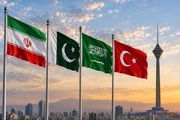
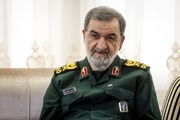
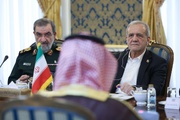
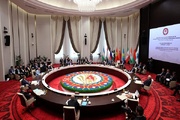
Saudi Arabia's Defense Minister Khalid bin Salman Al Saud, Pakistani Army chief Field Marshal Asim Munir and the chief of National Intelligence Organization of Turkey Ibrahim Kalin held a meeting with the Supreme National Security Council (SNSC) secretary Major General Mohsen Rezaei and President Masoud Pezeshkian as well as Foreign Minister Abbas Araghchi. The meeting was held in Saadabad Palace in the north of the Iranian capital.
The four-wat talks focused on regional security, the fallout from military aggression, and support for Palestine and Lebanon, the local Iranian media reported.
Earlier on Monday, Ali Bagheri, Deputy Secretary of the Supreme National Security Council, announced that senior officials from Saudi Arabia, Pakistan, and Turkey will travel to Tehran as part of efforts to implement the idea of endogenous security in West Asia.
Referring to General Asim Munir’s visit last week, Bagheri noted that the Pakistani army commander, in a meeting with Major General Mohsen Rezaei, the Secretary of the Supreme National Security Council, announced that senior officials from Saudi Arabia, Turkey, and Pakistan had decided to travel to Tehran, meet with Iran’s Supreme National Security Council Secretary, and hold a joint meeting.
The purpose of these senior officials’ trip is consultation with Major General Mohsen Rezaei regarding regional security, he stressed.
All three countries attending this meeting, along with Iran, can take an effective step toward creating endogenous security within the framework of Iran’s effective idea for regional security-building with the participation of regional actors, drawing on Iran’s successful experience in national security-building, he stated.
US-Zionist aggression strengthened Iran's national unity: Pezeshkian
President Pezeshkian at the meeting said that "The region has witnessed widespread Israeli crimes in recent years. A united front among Muslim countries could prevent Israel from continuing its aggression."
He also said "Israel thought pressure and military aggression would lead to Iran’s collapse, but instead strengthened national unity and solidarity."
"He further said, "Despite the losses and hardships, Iranians stood firm in defending their country. The belief that Iran can be forced to surrender is misguided."
Accoridng to Pezeshkian "Iran supports any understanding that leads to Islamic countries' unity."
He continued to say that, "Relying on shared capacities, Islamic states can present world with a model of justice, development"
Iranian officials reportedly told Reuters prior to the meeting that he Tehran meeting did not include talks on the nuclear issue as Tehran demand Washignton meet its conditions before any talks about the nuclear issue.
The talks centered on the war on Iran, US naval blockade and esclated tensions in the region.
FInal statement: Participants vow to continue dialogue
The delegations from Iran, Pakistan, Turkey, and Saudi Arabia released a press statement after concluding their security meeting in Tehran on Monday.
The participants agreed to continue the dialogue to strengthen cooperation amongst the four regional countries, including for peace and security in the region.
MNA








Your Comment