

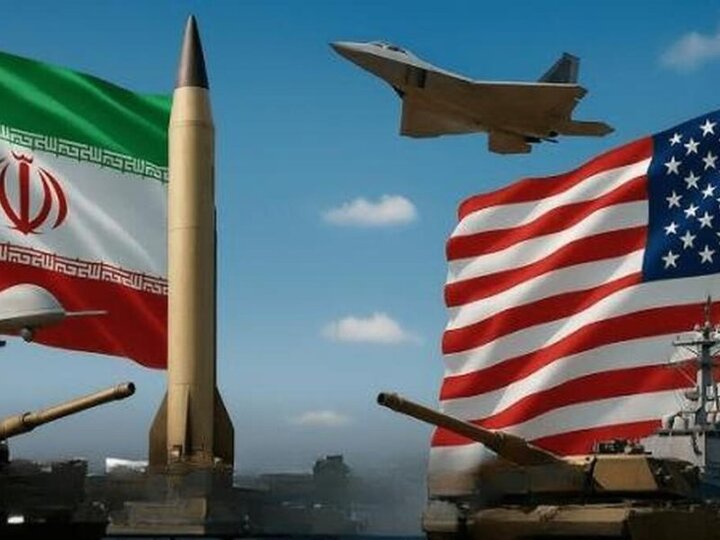
37 days after the start of the military aggression by the United States and the Israeli regime against Iran, not only have the declared objectives of the operation failed to materialize, but growing evidence is emerging of strategic deadlock and military as well as political setbacks for the aggressor parties. The war, which began with large-scale strikes and the killing of civilians, including innocent schoolchildren, quickly expanded into a crisis with broad humanitarian, security, and economic dimensions, prompting varied reactions across international media.
Media outlets around the world, each through their own editorial lens, have sought to shape the narrative of this war; examining these reflections can provide a clearer picture of the actual state of the conflict and its possible trajectory.
CNN
CNN reported on the contrast between Netanyahu’s defiant, biblically charged speech before Passover – where he compared Israel’s strikes to the ten plagues and claimed Israel had transformed the Middle East – and the immediate reality of a heavy Iranian attack hours later. The attack shattered the holiday calm and exposed the gap between his triumphant rhetoric and the military situation on the ground, more than a month into the US‑Israeli war against Iran. Opposition leader Yair Lapid quickly released a video calling Netanyahu’s words arrogant, pointing out that Iran had already been firing ballistic missiles at Israel before the war, and that after a month, nothing significant had changed. This exchange revealed deeper political and public divisions in Israel, as the initial optimism and unity seen in the cabinet’s early war days were fading.
The Guardian
The Guardian recalled Jimmy Carter’s famous “fireside” speech in 1977, when he wore a knitted sweater and urged Americans to set thermostats low to fight a chronic energy shortage. While environmentalists remember his promise to research solar and renewables, his most important commitment was the aggressive expansion of domestic coal, which his energy secretary called “America’s black hope.” The paper then drew a parallel to Donald Trump’s current situation: gasoline prices, adjusted for inflation, are now higher than in the winter of 1977 and could drive inflation to a three‑year high. Trump, the Guardian noted, is following the same old Carter strategy but with greater intensity – accelerating the development of US fossil fuels. The piece framed this as a historical echo, where a president facing energy pressures turns to domestic extraction rather than conservation or alternative sources, despite the different political contexts and environmental awareness of the two eras.
The Atlantic Council
The Atlantic Council argued that the war with Iran is an intelligence failure, but of a different kind than the Iraq War. It recalled that a 2005 bipartisan commission found the US intelligence community had been completely wrong about Iraq’s WMDs – claims that justified the invasion and eight years of occupation, none of which were verified. If a similar body reviewed the lead‑up to the current war with Iran, the assessment would likely be that this time, intelligence was accurate and consistent. Contrary to Trump’s justifications, available intelligence showed that Iran was not preparing to use nuclear weapons, did not have ballistic missiles capable of reaching US soil, and that if attacked by the US, Iran would probably strike neighboring Persian Gulf countries and attempt to close the Strait of Hormuz – an action that could trigger a global economic crisis. Thus, the failure lies not in faulty pre‑war assessments, but in political leaders ignoring or overruling accurate intelligence to start a war.
The Associated Press
The Associated Press reported that international aid groups are warning that the war in the Middle East has crippled their ability to deliver food and medicine to millions of needy people worldwide. The conflict has blocked vital shipping routes, caused a global energy crisis, and disrupted the supply chains of relief organizations, forcing them to use more expensive and time‑consuming routes. Key passages like the Strait of Hormuz have become effectively closed, and routes linked to strategic hubs such as Dubai, Doha, and Abu Dhabi have also been affected. Transport costs have soared due to higher fuel and insurance prices, meaning that with the same budget, a smaller volume of aid supplies can be sent. If the violence continues, the suffering will deepen, as humanitarian groups struggle to reach vulnerable populations across the globe. The AP emphasized that the war’s impact is not limited to the battlefield but extends to global humanitarian logistics, making an already strained aid system even more fragile.
Al-Masirah
Al-Masirah reported that Iran’s IRGC downed an American MQ‑9 drone over Isfahan, along with another drone searching for a downed US fighter pilot, and later a Hermes 900. Iranian air defenses are increasingly limiting enemy operations. Economically, the US‑Israeli war has raised US inflation and fuel prices, with diesel exceeding $8 per gallon in some cities. Politically, Trump is considering a major cabinet reshuffle due to war consequences. Iran shows coherent resilience, managing the conflict militarily, politically, and economically, reinforcing new deterrent equations in the region.
Al Jazeera
Al Jazeera focused on the war’s economic impact on Egypt. After optimistic Egyptian official statements about overcoming economic crises, the US‑Israeli attack on Iran and Tehran’s closure of the Strait of Hormuz led Egypt to raise fuel prices on March 9, 2026. The middle and lower classes saw their hopes for economic improvement vanish. The war proved prolonged, with price increases continuing as tensions rose among the conflict’s three parties. Promised relief never materialized.
Al Mayadeen
Al Mayadeen argued that the post‑war era will be completely different. US and Israeli war objectives have significantly declined, and their political, military, and strategic calculations have been unrealistic, ignoring field facts. Iran’s actions – targeting US bases, aircraft carriers, drones, fighter jets, tankers, and AWACS – have undermined US air superiority and shattered Washington’s credibility. Iran may be the first country to dare confront the US, raising urgent questions about future US military presence in the Persian Gulf, NATO, and regional security arrangements.
Al-Ahed
Al-Ahed wrote that Washington assumed external military pressure would ignite internal revolt in Iran – a simplistic idea seen from Vietnam to Iraq. But the first month of war showed a structural flaw: confusing internal contradictions with wartime political action. Iranian society, shaped by the Iran‑Iraq War, has a deep political memory. Long years of war did not collapse the system; instead, national and ethnic mobilization mechanisms reproduced it. External pressure failed to trigger the expected uprising.
Jang News
Jang News reported the war signals Western leadership's decline under Trump and Netanyahu. Failures include: European distance from the US, reduced credibility of Western democracy, and widespread public dissatisfaction in the US and Europe. Key institutions like NATO and the UN have lost effectiveness. Economic instability and rising prices confirm the failure. This shift marks the decline of the Western‑centered order and offers an opportunity for Eastern powers to gain strength.
Hurriyet
Trump said at a private White House meeting that states should handle healthcare for the elderly and poor because the US is busy with war. A 67‑minute video was briefly uploaded and then deleted. Trump’s 2027 budget requests $1.5 trillion for the Pentagon – a 44% increase from last year. The $440 billion extra will come from cutting programs for the elderly, cancer patients, rural residents, workers, the unemployed, homeless veterans, small businesses, and clean drinking water – eliminated with a “chainsaw.”
Global Times
Global Times argues that Trump’s threat to leave NATO is not merely a personal issue but a sign of the alliance’s gradual decline since the Cold War. With the Soviet threat gone, NATO has been forced to invent new enemies – from Eastern Europe to the Indo-Pacific – to justify its existence. US and European interests have diverged: Europe bears the costs of the Ukraine war (energy, migration, industrial exodus) and resists joining the war against Iran. Meanwhile, US federal debt has surpassed $36 trillion, making global military spending unsustainable. Trump is a symptom, not the cause, of unresolved pressures accumulated since the USSR’s collapse. The idea of an “economic NATO” against China is impractical and self-defeating due to internal disagreements. In sum, America’s decline due to NATO’s crisis and the Iran war is certain.
Haaretz
Haaretz argues that the war against Iran may fundamentally transform US‑Israel relations. As Trump’s failure becomes clear, a blame game will begin, one‑sidedly favoring the US, with all fault falling on Israel. This could lead to a chain reaction, turning Israel into an isolated, rejected actor without American backing. The author claims this sick relationship should have ended long ago: Netanyahu acted against US wishes and disrespected America more than any premier, while the US still condemned attacks on Israel, vetoed against it, and sent weapons. Europe, fearing the US, stayed silent but now awaits a chance to take revenge alongside large parts of American public opinion. The war could be a turning point; both parties await a rupture. If unconditional US support ends, it might force deep policy changes in Israel, but also risk Israel’s survival without American weapons, money, and veto power. That day is closer than it seems.
MNA














Your Comment