


Hafez, the famous Iranian poet, has a meaningful poem that is sometimes used as a proverb. This verse is usually said to describe someone who has a low and despicable personality but tries to insult great people. Hafez, addressing the lowly person, says:
O fly, the arena of the Simorgh is not yours
You are ruining your reputation and causing difficulty
In this verse, the fly is the lowly person, and the Simorgh is a high-ranking person, and Hafez, in a position of humiliation, is saying:
“O fly! You are not worthy of flapping your wings and fluttering around the Simorgh! By doing this, you are ruining your reputation and causing others difficulties .”
At the present time, the subject of this verse is a lowly person named Donald Trump, who, although he is despicable, tries to hide his despicableness by repeatedly insulting a great and high-ranking figure such as Ayatollah Khamenei. In fact, he, who himself has no reputation due to financial and sexual corruption and his move towards global dictatorship, is also plundering the reputation of the American government and nation by insulting the elders.
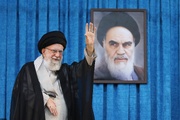
Trump and his like-minded people know very well that Ayatollah Khamenei is not only a prominent Islamic scholar and a resourceful politician, but also that with his coherent mind and abundant intelligence, he has been able to express theories in various intellectual fields and show his distinguished personality to the world. He is a scientist who knows the times and who, with his guidance, has led a civilization-building phenomenon called the Islamic Revolution after its great founder, Imam Khomeini, and guided it towards achieving its goals.
He, in the Iranian government system, is the "Supreme Leader of the Islamic Revolution," who, despite having political power and extensive legal authority, has never been and will never be a dictator. Despite having the guardianship over the country's financial power, he has always been and will always be pure and clean-handed.
At no time in Ayatollah Khamenei's life, whether in his youth, middle age, or during the struggle, was he devoid of communication, connection, and solidarity with the people, and during his leadership and guardianship, he was a ruler of the masses in every sense of the word. With this belief, he has always called on the authorities of the Islamic Establishment to serve the people, saying: "In a country whose demographic structure is among the youngest in the world, no factor can ensure the security and health of this country, the continuation of the rule of the system, and the possibility of work and construction except for connection with the people, and this connection and communication is only possible in the shadow of the good deeds of the authorities."(15/3/1997)

The leader of the revolution is just an intelligent individual who is determined to spread justice and simplicity among the nation. He believes that the existence of justice in society will benefit all people, and on this basis, he promotes the discourse of "resistance economy" in the sense of strengthening the economy by utilizing domestic capacities and increasing production to implement economic justice; a discourse that has been accepted by independent and developing countries today.
This brave leader, while believing in the necessity of establishing peace in the world, believes that today the world needs peace based on justice more than ever before, and he stands up to defend the rights of humans and the oppressed against dictatorial regimes like the United States and arrogant leaders like Trump, calling on the world to stand up. In fact, he recommends "justice-based" solutions to solve world crises against hegemonic powers that endanger world peace and security by proposing discourses lacking morality and justice, and acting against peace under the guise of peace in regions like Palestine.
But the most prominent dimension in Ayatollah Khamenei's personality is the cultural dimension, which is less known due to the prominence of his political dimension. The leader of the revolution has characteristics that are rarely seen among world leaders. He loves reading books and is a professional book reader. His familiarity and even proficiency in a wide range of humanities such as philosophy and mysticism, poetry and literature, history, social sciences, art and cinema, and political sciences is exemplary, and in the field of statecraft and discourse-building, his attention to cultural independence is quite prominent.
In Ayatollah Khamenei's view, culture is the main source of identity for nations. It is the culture of a nation that can make that nation advanced, beloved, capable, knowledgeable, technological, innovative, and have a global reputation. He also considers the secret of the fall and decline of civilizations to be the weakness of culture and believes that the independence of a nation cannot be secured and maintained except through cultural independence. One of these concepts proposed by the Leader of the Revolution is the concept of cultural invasion, which is applied by hegemonic countries and seeks to impose foreign cultural values through soft sources such as new media. He believes that the cultural resistance of civilized countries against foreign cultures is necessary to confront the monoculturalization of the world, which is one of the policies of the hegemonic system.
The outstanding qualities of Ayatollah Khamenei, some of which were mentioned, have caused not only Muslims but also many people around the world to join the ranks of followers and admirers of the Leader of the Revolution, and a wide range of intellectuals and thinkers of the world have put research and study into the dimensions of his thoughts on the agenda. Despite this, the extensive propaganda of the Western and Zionist apparatuses will never be able to harm his divine and enlightened personality, because God the Almighty is his protector and preserver and protector of the Islamic system.










Your Comment