

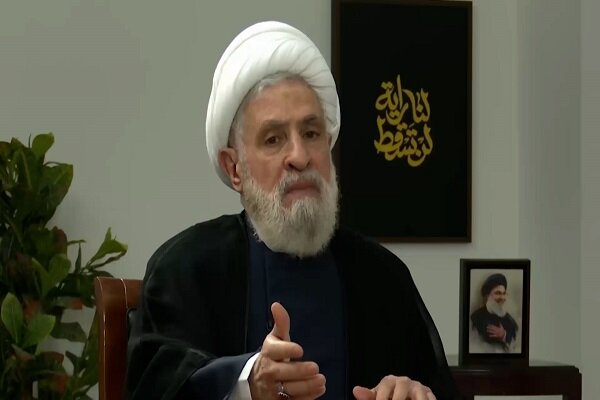
In his first interview with Al Mayadeen since assuming the leadership of Hezbollah, Sheikh Naim Qassem spoke to Al Mayadeen's chairman of the board of directors, Mr. Ghassan Ben Jeddou, offering a detailed account of the Resistance's strategic decision to enter the ongoing war on Gaza through a "support battle" rather than a full-scale war.
Sheikh Qassem described the move as the product of collective deliberation within Hezbollah’s Shura Council, marking a pivotal moment in the group's evolving response to the Israeli occupation's war on Gaza. Sheikh Qassem revealed that Hezbollah’s Shura Council convened and unanimously decided to enter the support battle for Gaza. He emphasized that this decision was not taken lightly nor through phone calls. “This kind of decision cannot be made via phone calls or casual communications. It required an urgent in-person meeting,” he said, adding that the decision came two days after the start of the war, while Hezbollah had already begun launching attacks from Shebaa Farms on October 8.
Responding to the question of why Hezbollah chose a limited support operation rather than an all-out war, Sheikh Qassem stated that a full-scale war demands significant prior preparations. “The outcome of a full war is predictable. It requires preparedness that simply wasn’t available,” he said. Instead, Hezbollah opted for a measured approach. “We had to enter the battle with limited support and observe developments closely. Based on how things evolved, we could make a clearer choice,” Sheikh Qassem explained.
Goals of engagement in support operation
Weeks into the operation, the Shura Council solidified its decision to pursue a support war rather than a comprehensive one. According to Sheikh Qassem, this approach successfully achieved Hezbollah’s strategic objectives without escalating into full-scale conflict.
Sheikh Qassem outlined three primary goals behind Hezbollah’s engagement: Diverting the Israeli occupation forces: “We aimed to draw a significant number of Israeli forces to northern occupied Palestine,” he said; creating social pressure: Hezbollah sought to force the evacuation of Israeli settlers from the north, thereby triggering a social, economic, and security crisis; inflicting casualties: “The more soldiers we kill, the more we push Israel closer to defeat,” Sheikh Qassem asserted.
These tactics, he said, helped deplete Israeli military capabilities near Gaza and the surrounding areas, easing pressure on the besieged population in the Strip. “It also sends a clear message to the Israelis that they are facing a two-front war, and that it is in their interest to find a solution and bring this to an end,” he added.
Republished from Al Mayadeen English website
No prior coordination
Sheikh Qassem denied that Hezbollah had any prior coordination with Hamas before the October 7 operation. “We simply didn’t know. If we weren’t aware, how could we join a comprehensive war from the start?” he said.
He disclosed that Hezbollah later received a message from the commander of Hamas’ military wing, martyr Mohammed Deif, via a Lebanese intermediary. Sheikh Qassem added that discussions were held in Beirut with senior Hamas official Khalil al-Hayya and his delegation during their visit. According to Sheikh Qassem, both Hezbollah and Palestinian factions, including in a meeting with the late Sayyed Hassan Nasrallah, reached a shared conclusion: the support operation was sufficient to serve the resistance's broader aims.
“For two months, we assessed whether this level of support was enough. But we came to see that the Israeli aggression was extreme, supported by new rules of engagement and US backing,” he said. “Doing more than support would not have changed the outcome.”
Sheikh Qassem clarified that, based on his information, Iran was not informed in advance of Hamas’ plans. “In fact, even parts of Hamas’ leadership abroad weren’t aware,” he noted. Still, he stressed that Iran’s unwavering support for the Palestinian cause, militarily, financially, politically, and even through intelligence and media, has continued uninterrupted. “Whether they told us or not, our stance remains firm in supporting Palestine, especially during this strategic phase of the al-Aqsa Flood,” he said.
Breaches that affected Hezbollah being investigated
In the second installment of his exclusive interview with Al Mayadeen, Hezbollah Secretary General Sheikh Naim Qassem addressed the recent security breaches that shook the organization, revealing ongoing internal investigations and new details about the scope and nature of the infiltration.
Sheikh Qassem confirmed that a central investigative committee had been formed and was still working, alongside several subcommittees examining specific aspects of the breach, including the booby-trapped pagers, the location of Sayyed Nasrallah’s assassination, and the assassination of Sayyed Hashem Safieddine. He said various monitoring and investigation points had also been established.
Rigged pagers, untraceable explosives
On the issue of the rigged pagers, Sheikh Qassem revealed that investigations uncovered a serious vulnerability in the procurement process over the year to year and a half leading up to the purchase. “We did not know the supply chain had been exposed. With the means available to us, we could not detect the presence of explosives,” he admitted. He explained that the type of explosive device used inside the pager was highly advanced and undetectable by standard methods. “This could be seen as a failure, or as a limitation of our capabilities,” he said.
In the days just before the pager explosion, Hezbollah’s team had already begun to suspect a malfunction. “There were efforts to examine the pager differently, including attempts to break it open, which were prompted by some anomalies that raised questions,” Sheikh Qassem noted.
As to whether the Israeli regime detonated the device out of fear it might be discovered, he said, “That’s an Israeli assessment. Perhaps they feared we were close to exposing it.”
Massive surveillance, not human espionage
Sheikh Qassem also acknowledged a serious gap in Hezbollah’s awareness of the scale of Israeli surveillance, particularly through electronic and aerial means. He said Hezbollah had received reports indicating possible wiretapping, but “we did not realize the extent, that it was near-total and very extensive.”
He said "Israel" has been collecting data through aerial surveillance over a 17-year period, documenting geographical and infrastructural changes. “We didn’t have the capacity to grasp how deep Israel’s information gathering had gone,” Sheikh Qassem admitted.
In light of this, Sheikh Qassem argued that human espionage now plays a secondary role compared to the technological intelligence capabilities deployed by Israel. “Frankly speaking, the human breach appears very limited compared to the immense volume of data collected through surveillance and drones,” he said.
He firmly denied any evidence of a widespread human infiltration within Hezbollah’s ranks. “There is no indication of any significant breach involving core figures or senior commanders,” he stressed, pledging transparency. “If we find there has been human penetration, I will speak publicly and disclose the level of that breach.”
1,500 bugged devices intercepted
Sheikh Qassem also disclosed that Hezbollah intercepted a shipment of roughly 1,500 bugged pager devices in Turkiye. The discovery was made after the initial pager explosion. Hezbollah immediately contacted Lebanon’s caretaker Prime Minister Najib Mikati, who in turn reached out to Turkish President Recep Tayyip Erdoğan, requesting the devices be destroyed. “This issue was addressed swiftly after the explosion,” Sheikh Qassem said.
As for speculation that similarly rigged military armor or protective gear may have been intended for Hezbollah fighters, Sheikh Qassem stated: “I have no information to confirm that.”
Sheikh Qassem addressed the future of the party following months of war and the loss of top leaders, including the late Sayyed Hassan Nasrallah. He emphasized resilience, determination, and the readiness to confront any future Israeli aggression.
'A people that cannot be defeated'
Sheikh Qassem reassured supporters that Hezbollah, despite the severe blows it had endured, is not a defeated force. “A people like this, an Ummah like this, a party and resistance like this, cannot be defeated,” he declared. “Do you expect anything less than for us to remain present, strong, and capable of shaping the future we choose?”
Referring to the attacks that targeted Hezbollah’s advanced capabilities, including the bugged pagers and communications systems, as well as the assassination of Secretary-General Sayyed Hassan Nasrallah, Sayyed Hashem Safieddine, and a group of top commanders and lower-ranking officers, Sheikh Qassem said the Israeli occupation had assumed Hezbollah would collapse. “And yet, here we are, back on our feet, engaged in fierce battle, and forcing Israel to agree to a ceasefire. What does that say?” he asked.
He listed what he called the elements of victory: Hezbollah’s continued operations, the Israeli failure to penetrate deeper into Lebanese territory or reach Beirut or Sidon, and the preservation of Lebanese unity. “They failed to spark internal strife. They failed to destroy the party. They failed to achieve their objectives,” he affirmed.
'Our patience has limits'
Commenting on the Israeli occupation's expanding aggression, including recent attacks on Beirut’s southern suburb, Sheikh Qassem warned that Hezbollah’s patience was not unlimited. “Resistance will not wait forever. There are limits,” he stated. While he did not disclose timing or methods, he underscored that when the decision is made, “there is no third option between victory and martyrdom. We do not have surrender as an option.”
He attributed the Israeli occupation's escalated operations to US policy, saying Washington hopes to gain through diplomacy what it failed to achieve militarily. “Their strategy is: ‘Let’s use diplomacy to get what we couldn’t in war.’ So the Americans apply pressure through Israel,” he said.
Sheikh Qassem praised Lebanese state leaders for their unified position. “I salute President Joseph Aoun, Speaker Nabih Berri, and all officials involved in what has become a remarkable display of national unity.”
Martyrdom of Sayyed Hassan Nasrallah
In deeply personal remarks, Sheikh Qassem reflected on the loss of Sayyed Hassan Nasrallah, calling it a devastating shock not only to the public but also to Hezbollah’s leadership. “His martyrdom was not only unexpected to the world, it was unexpected for us,” he said. “If you had asked me before, I would have said all of us might fall before Sayyed [Nasrallah] does. That’s how strong, courageous, and divinely guided he was.”
“It was not easy to imagine his departure,” he added. “Perhaps this was part of a divine secret. We do not know when our time comes. But he earned his rest, and he rose to the highest rank. We consider martyrdom the greatest honor, and he received the highest honor.”
Sheikh Qassem described the moment he learned of the assassination. “At first, I was in denial. I thought maybe the news wasn’t true, maybe he wasn’t hit, maybe he was still alive somewhere. But the next day, the brothers confirmed the body had been recovered. That’s when the truth settled in.”
The greatest challenge now, he said, is carrying on in the absence of a leader whose strength, tone, energy, and stance were irreplaceable. “We don’t cry because he’s gone, we cry because we don’t know how to compensate for what we’ve lost,” Sheikh Qassem said. “But martyrdom doesn’t stop the path; it nourishes it.”
“We are now charged with continuing this mission at the level of his sacrifice. With sincerity and resolve, we ask God to help us carry this responsibility.”
Assuming the leadership of Hezbollah
Sheikh Qassem opened up about the tense days following the assassination of Sayyed Hassan Nasrallah, recounting his first public appearance, the burdens of leadership, and how Hezbollah transitioned into a new command structure while under fire.
After the assassination of Sayyed Hashem Safieddine, Sheikh Qassem formally assumed the role of Secretary General, with direct responsibility for overseeing Hezbollah’s military operations. He said that shortly after taking the helm, he was asked by an Iranian military leader and a Lebanese commander outside Hezbollah how he would manage a military campaign.
Sheikh Qassem explained that the Secretary-General is, by party structure, also the head of the Jihadi Council, responsible for directing military affairs. “Now that I was in this position, I had to intensify communication with relevant commanders and better understand operational details,” he said.
He laid out three key qualifications for leading Hezbollah and its resistance project: The ability to organize and lead effectively, a deep understanding of Hezbollah’s mission and strategic vision, and familiarity with the party’s structure, resources, and internal workings. “All of these were present,” he affirmed, noting that he had served as deputy for 32 years and was an active member of the Shura Council throughout.
Process of making military decisions
Sheikh Qassem offered a rare insight into Hezbollah’s military decision-making process, emphasizing that all major decisions, from naming unit leaders to launching operations, are made collectively within the Shura Council. “There is no appointment without deep discussion.”
He added that proposed battle scenarios, such as the Qalamoun campaign, Hezbollah’s entry into Syria, or decisions to retaliate against Israeli actions, are always brought before the council. “We might say: this is our proposal, the Jihadi Council recommends this course. Should we strike this way? Launch a drone? Fire a rocket? All of this goes through internal deliberation,” he said.
Sheikh Qassem stressed that Hezbollah continued to function in an organized fashion even amid heavy attacks. “Hezbollah was run as if it still had a secretary general. No one outside the leadership was making the decisions.”
He detailed how operational decisions were made for each escalation. “When Tel Aviv was struck, that had its own directive. When the strike hit Netanyahu’s residence, that required a specific order. Even what the enemy calls ‘Black Sunday’ on November 24, 370 rockets and drones in one day, that too was based on a formal decision.”
The Tel Aviv strike: Meticulously coordinated
Sheikh Qassem emphasized that the strike on Tel Aviv was not spontaneous but the result of deliberate planning and leadership oversight. “The Secretary-General was following developments closely through the military command,” he said, referring to martyr Sayyed Nasrallah, who remained engaged in strategic oversight until the last moment.
He described the military command structure at the time of the strike as fully intact. “Every position in the military command was occupied. No seat was left vacant,” he stated, adding that contingency plans were implemented quickly after leadership losses.
Sheikh Qassem acknowledged that Iran had provided consultations, for which he expressed gratitude, but stressed that the decisions came from Hezbollah’s own organizational framework. “While we appreciate the Iranian advice, the decisions related to our military structure were made internally,” he noted.
He cited a specific instance to illustrate the level of coordination: the timing of his third public speech, which was immediately followed by the Tel Aviv strike. “How could the two occur back-to-back unless there was a detailed, prearranged plan?” he asked rhetorically.



Your Comment