

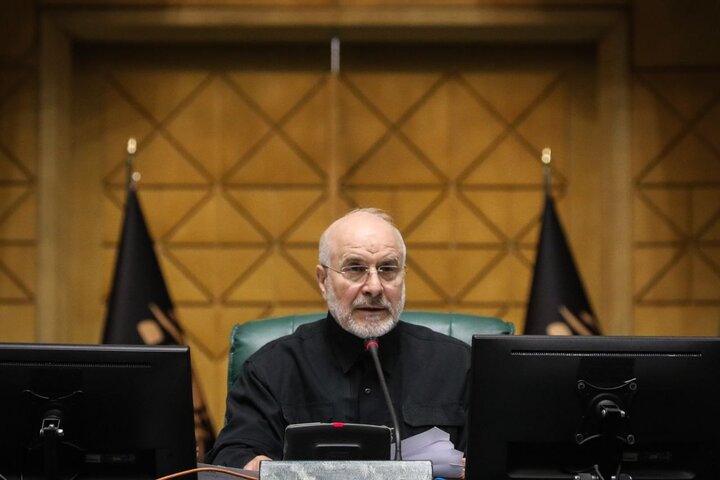
Mohammad Baqer Qalibaf, Iran's special representative for China affairs, said developing strategic relations with China must move from paper agreements to operational cooperation and tangible economic and political results, in an article marking the 55th anniversary of diplomatic ties.
Qalibaf said Iran-China relations have passed through major regional and international developments over more than five decades, calling the continuity of these ties valuable capital whose importance grows when it is converted into deeper and more durable cooperation suited to new global conditions.
He described the Leader's attention to developing balanced relations with China as reflecting a strategic view of foreign policy and the international economy, and said engagement with major powers, especially China, must not be limited to ceremonial agreements but must be built on mutual interests, tangible achievements and sustainable cooperation.
Qalibaf said the final assessment of cooperation should be based on operational projects, concrete outputs and real added value for national interests.
He outlined four main axes as a road map for developing Iran-China engagement.
The first is China's role in ending the war and moving beyond the neither-war-nor-peace situation. Qalibaf said China's experience in countering U.S. unilateralism and supporting the strengthening of the Global South can provide important opportunities for Iran, and that Tehran-Beijing cooperation and synergy can help resolve existing problems while consolidating the strategic relationship.
The second axis is China and a new regional security architecture. Qalibaf said recent developments have shown that sustainable regional security must be provided through the role of regional countries, and that reliance on security imported from outside powers cannot meet the region's needs. Citing China's relations with Iran and other Arab countries, he assessed Beijing's role in shaping a new regional order and increasing stability as important.
The third axis is structural change in the international system and the world's move toward a multi-centered structure. Qalibaf said Asia's share and that of developing countries and emerging economies in global economic and international relations is rising. Citing shared positions on respect for national sovereignty, the independence of states, multilateralism and countering unilateralism, he said using the capacities of the Shanghai Cooperation Organisation and BRICS is important for raising Iran's international standing.
The fourth axis is expanding economic, technological and long-term investment cooperation. Qalibaf stressed the need to increase the share of joint production, technology transfer, investment and development cooperation in Tehran-Beijing relations.
Referring to the 25-year comprehensive cooperation program, Qalibaf said it provides a long-term framework for directing bilateral cooperation, but its realization requires defining specific projects, executive agreements, financing and accountability from relevant bodies and companies.
He also identified coordination between Iran's Seventh Development Plan and China's 15th Development Plan as one of the important ways to accelerate bilateral relations.
Qalibaf stressed the need for coordination among government bodies, the private sector, economic institutions, universities and scientific and technological centers, saying the diversity of cooperation capacities with China becomes an advantage only when it has national direction and coordination.
He described the special representative's mission as helping create cohesion, set priorities, speed up decisions and follow up on major and cross-sectoral issues, adding that this mission should not replace the bodies responsible for implementation.
According to Qalibaf, forming a headquarters with a role in policymaking, strategic guidance, resolving conflicts and overseeing implementation can help increase coordination and the effectiveness of bilateral cooperation.
He stressed that the will of Tehran and Beijing to expand and deepen relations is high, but what matters is the formation of a coherent chain from decision-making to implementation and evaluation of results, so that every major agreement has a clear implementation path, defined responsibility, a financing mechanism and the possibility of assessing progress.
MNA







Your Comment