


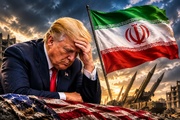
The war on Iran has evolved into one of the most significant political crises for the Donald Trump administration—a crisis whose repercussions extend well beyond the battlefield, reaching the electoral arena, Congress, the White House, and even the future of the Republican Party (GOP). What is unfolding in Washington today is not merely a disagreement among a few US officials over whether to continue or halt military operations; rather, it is a sign of a strategic crisis that has confronted the Trump administration with a difficult question: How can they extricate themselves from the Iranian quagmire without such an exit being perceived as a defeat for the United States?
Trump entered this fray under thinking that by displaying military power and exerting intense pressure, he could alter the strategic calculus in Iran and secure a quick victory. However, subsequent developments revealed a vast gap between Washington’ objectives and the actual outcomes of this policy—a gap far wider than initial calculations had suggested. Not only remains the Iran issue unresolved, but the economic, political, and electoral costs of this decision have now rebounded onto the domestic front in the United States.
Defeat in Elections: A huge blow to Trump
The most telling indicator of this situation is the crushing defeat suffered by the Republicans in the midterm elections on November 5, 2026—an election in which the Democrats secured control of both the House of Representatives and the Senate.
This is more than just a partisan setback. As he enters the final two years of his presidency, Trump now faces a Congress controlled by his political opponents. Such a scenario could complicate the passage of the administration’s economic, budgetary, and policy agendas, while severely restricting the White House’s room for maneuver.
Yet, the more significant message emerging from these elections is the emergence of a rift within Trump’s electoral coalition. A segment of the electorate that had supported him in 2024 voted for the Democrats this time around. Furthermore, polls indicated that approximately 60 percent of voters viewed US military action against Iran as a misguided decision.
Against this backdrop, Vice President J.D. Vance explicitly stated that the war with Iran was the primary reason for the Republicans' defeat. He even emphasized that his earlier recommendation to end the war had been the correct course of action.
These remarks should be viewed as a significant admission from within the US administration: a policy intended to showcase Trump’s strength has instead become a factor that has weakened his political standing.
Vance’s Four-Point Plan for a Comeback
In response to the electoral defeat, Vance proposed four key areas to rebuild support among dissatisfied voters: ending the war with Iran, focusing on the cost of living and inflation, returning to an "America First" policy, and altering Washington’s relationship with Israel.
These four points are not coincidental; they directly address the specific areas where the Trump administration encountered discontent among segments of its own electoral base.
Trump had managed to secure the support of a significant portion of the American public by promising to avoid foreign conflicts and prioritize domestic issues. However, engaging in a costly campaign against Iran created a serious contradiction with that promise.
Now, Vance is attempting to realign himself with those original slogans. Beyond the disagreement over foreign policy, this stance could signal a political distancing from Trump and serve as groundwork for a potential presidential bid in 2028. Netanyahu at the Center of Disagreements
Another dimension of the crisis concerns the relationship between the United States and Israel. American website Axios reported that, in private meetings, Vance has sharply criticized Benjamin Netanyahu regarding issues related to Iran, stating that the Israeli Prime Minister is wrong on almost all of these matters.
This stance indicates a serious disagreement within the US administration regarding the extent to which Tel Aviv’s calculations influence Washington’s decision-making.
Indeed, a key question is whether the US entry into this conflict is based on a realistic assessment of Iran’s capabilities, or if Netanyahu’s calculations regarding the consequences of military action have exerted an excessive influence on Trump’s decisions.
Conversely, Pete Hegseth, the US Secretary of War, remains one of the staunchest advocates for continuing a military-focused approach, whereas Vance and Secretary of State Marco Rubio favor advancing an agreement.
Trump’s Three Difficult Paths
Trump currently faces three primary options. First, the resumption of military operations—a move that could escalate the crisis and impose greater economic and security costs on the United States.
Second, advancing an agreement with Iran—a path that could halt the conflict, though Trump’s domestic opponents might see it as a retreat from the stated objectives of the United States.
Third, continuing the status quo—that is, maintaining economic and maritime pressure without returning to large-scale operations and without reaching a durable agreement.
Recent reports indicate that none of these options offer an easy exit strategy for Trump. Even US intelligence assessments suggest that fresh attacks would not necessarily alter Tehran’s negotiating position, nor would they lead to a change in Iran’s political system.
Defeat Beyond the Battlefield
The significance of recent developments must be understood through their broader consequences for the United States: the loss of control over both chambers of Congress, rifts within the Republican party, divisions at the highest levels of the administration regarding the continuation of operations, and growing uncertainty surrounding Washington’s relationship with Israel.
These are dimensions of a crisis that cannot be ignored merely by declaring a military victory or issuing political statements.
Trump now is in limbo: resuming military operations could entail even higher costs; reaching an agreement would draw accusations of a retreat; meanwhile maintaining the status quo would leave the crisis unresolved.
For that, the maneuvers by Vance should be viewed as an attempt by a portion of the US political establishment to find a way out of crisis.
The war with Iran is no longer just a foreign policy issue for Washington; it has become a catalyst for Republican defeat in votes, internal divisions within the US leadership, and a struggle over the country’s political future. A conflict intended to strengthen America’s position has, in fact, become one of the most significant political challenges for the Trump administration.
MNA















Your Comment