


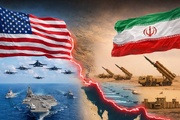
The two-week ceasefire between Iran and the United States, which is supposed to serve as a framework for de-escalating tensions following the aggressions of Washington and Tel Aviv against Iran, has not yet been fully implemented. This agreement explicitly includes the cessation of military actions against the pillars of the Axis of Resistance – including Lebanon – but what has happened on the ground is not a halt to the war, but rather the beginning of a new phase of aggression.
In the first hours after the announcement of the ceasefire, the Zionist regime launched extensive attacks on southern Lebanon; attacks that continued today as well. The Jouaiyya area in Tyre was targeted by airstrikes, Bariqa in Nabatieh was attacked by drones, and within just one hour, five drone attacks were recorded on the town of Toul. This process did not end there; Deir El Zahrani, Al-Kharayeb in Sidon, Al-Mansouri, and Sir el Gharbiyeh were also added to the list of attack targets. Even in Al-Kharayeb, a car was directly targeted with a missile – a pattern indicating a shift from deterrent strikes to assassination-oriented operations.
These attacks are a continuation of the same wave that, only one day earlier, had plunged Lebanon into an unprecedented shock. The extensive and sudden attacks by the Zionist regime across Lebanon – including Beirut – which, according to official sources, targeted over 100 civilian sites in just 10 minutes, resulted in the martyrdom of 203 people and the injury of more than a thousand. This level of violence has been rare in Lebanon in recent years and shows that what is underway is not a limited operation, but a designed strategy to change the rules of the game.
In the meantime, the Israeli army's claim of targeting Hezbollah leaders and military infrastructure stands in clear contradiction to the facts on the ground. Field reports and statements by Lebanese officials indicate that a significant portion of the victims were civilians. This gap between claim and reality not only questions the legitimacy of Israel's military actions but also once again highlights the instrumental use of the concept of "military targets" to justify massive attacks on residential areas.
But what elevates these developments beyond a mere security crisis is their direct link to the ceasefire agreement between Iran and the United States. Contrary to Benjamin Netanyahu's claim that he tried to define the military operation in Lebanon as outside the framework of this agreement, the text and spirit of the agreement clearly included the cessation of attacks on all pillars of the Axis of Resistance – including Lebanon. This point had been emphasized not only by Tehran but also by the mediators, including Pakistan.
Within this same framework, statements by Iranian officials present a clear picture of Tehran's position. Masoud Pezeshkian, the President of the Islamic Republic of Iran, explicitly declared that the renewed aggression of the Zionist regime against Lebanon is a "clear violation of the initial ceasefire agreement" and that continuing this process will make negotiations "meaningless." His key phrase – "our hands remain on the trigger" – reflects an active deterrence doctrine according to which any violation of commitments will be met with a proportionate response.
Mohammad Bagher Ghalibaf, the Speaker of Iran's Parliament, also emphasized that "Lebanon and all pillars of the Axis of Resistance are an inseparable part of the ceasefire agreement," effectively rejecting any limited interpretation of the agreement. His reference to the fact that the issue of Hezbollah is the first clause of the 10-point agreement highlights Lebanon's strategic importance in the ceasefire equation. Also, his reminder of Shehbaz Sharif's positions and his emphasis that "there is no room for denial or retreat" indicate an effort to consolidate Iran's legal and political narrative of this agreement.
At this point, a key reality reveals itself: a ceasefire, if it does not include Lebanon, is fundamentally meaningless for Iran. This is not an emotional stance, but the result of a strategic calculation. Lebanon, as one of the main pillars of the Axis of Resistance, holds a decisive position in Iran's regional security structure. Therefore, any attempt to separate Lebanon from the ceasefire equation would mean rendering the entire agreement ineffective.
From an analytical perspective, Israel's behavior can be interpreted within the framework of a multi-layered strategy: first, an attempt to destroy the ceasefire by creating new realities on the ground; second, provoking Iran into a reaction, thereby shifting the label of "agreement violator"; and third, rebuilding its strategic position in a situation where it has been sidelined from the negotiation process. This is the same pattern that in international relations literature is referred to as "diplomacy through escalation."
In contrast, Iran's position is also taking shape as a clear doctrine: "comprehensive ceasefire or nothing." In other words, Tehran has implicitly conveyed the message that unilateral adherence to an agreement that is being violated on the ground is neither logical nor sustainable. Under such circumstances, continuing attacks on Lebanon not only discredit the ceasefire but will fundamentally block any path to negotiations.
This point is of particular importance: when an agreement is violated within its very first hours, and the other side tries to limit its scope through contradictory statements, one can no longer speak of a "negotiation process" as a genuine path. In such a situation, negotiation becomes a tool for managing time, not for resolving the crisis.
Accordingly, it can be said that what is happening today in Lebanon is not merely a military aggression, but a test of the credibility of the entire diplomatic system in the region. If blatant violations of agreements remain without cost, then not only this ceasefire but any possible future agreement will be discredited in advance.
Ultimately, Lebanon has today become the front line of a larger equation; an equation in which the fate of the ceasefire, the credibility of negotiations, and the regional balance of power are all intertwined. Tehran's message in this is clear: without a complete halt to attacks on Lebanon, there will be no ceasefire, nor will negotiations have any meaning.
If the ceasefire is to remain stable, it must also be recognized on the ground; otherwise, what remains is merely a word on paper, and a battlefield still burning in flames.
MNA









Your Comment