

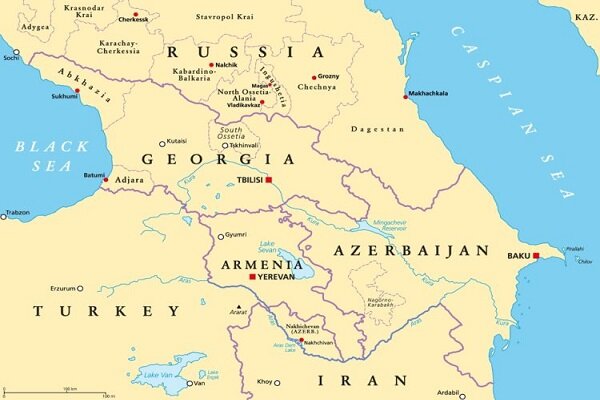
On the eve of new US moves in the South Caucasus, the visit of US Vice President JD Vance to the region has been accompanied by widespread speculation about Washington's real goals. This visit took place in a situation where the South Caucasus has become one of the main centers of geopolitical competition between great powers. Many analysts believe that these moves could have serious consequences and risks for the countries of the Caucasus and affect the geopolitics of the region.
In this regard, the following points are important.
1. JD Vance has announced that during this trip, he is seeking to strengthen US trade and economic cooperation with Armenia and the Republic of Azerbaijan. However, some other statements by American officials and speculations made by American media indicate that the main purpose of this trip is to examine the possibility of building a railway and a road connecting the Republic of Azerbaijan to Nakhchivan via Armenia, a route called Zangzur. This route is adjacent to the Islamic Republic of Iran, and Iran shares a border with it along the Aras River.
Under the pretext that they intend to establish peace in the Caucasus, the United States introduces the issue of Zangzur, which is located in the Syunik province of Armenia, as a factor or obstacle to peace, and says that they will help peace by having their companies in this region and building a railway and a road. In contrast, such a claim does not correspond to reality. The appearance of the matter is peace; just as the Americans acted completely in favor of Israel in the so-called Gaza peace plan, and in the end, not only were the interests of the Palestinian people not secured, but the crisis was exacerbated. Also, in the Ukraine case, they failed to achieve the goals they claimed were peaceful, and the region once again fell into a warlike and unpredictable future. The situation is similar in the Caucasus; they enter with a peace-loving face, but their main goal is to create challenges and instability in the region.
2. The US's motivation for being present in the Caucasus is not a benevolent one. The United States seeks to compete with and challenge Russia and, if possible, tries to target Russian interests in the region. At the same time, the US tries to be present near Iran to make threats against the country if necessary. Iran does not accept this issue and considers the US presence near its borders unacceptable.
The Caucasus is not given a very prominent place in the US strategic documents and major plans. However, as mentioned, given the West's conflict with Russia over Ukraine, both the United States and European countries tend to be present in areas that are considered part of Russia's sphere of influence and jeopardize the country's interests in order to gain concessions from Russia in the Ukraine case. For this reason, the Americans have also shown attention to the South Caucasus. The Americans are trying to weaken the influential countries in the Eurasian region, countries whose axis is Iran, China, and Russia. That is why they have also shown special attention to the South Caucasus region.
3. Iran has previously expressed its concerns to Armenia and the Republic of Azerbaijan and has said that it is necessary for this crossing to be built by regional engineers from the Republic of Azerbaijan and Armenia. The reason for this emphasis is that the presence of the United States, with its belligerent approach and nature in the Caucasus, could cause insecurity on this route. In such circumstances, Azerbaijan and Armenia, which intend to use this route safely, may face serious problems in the future. Armenian officials have promised Iran to manage this issue and not allow the United States to carry out activities near the Iranian border, even under the cover of private companies.
4. At the same time, Iran has always emphasized that cooperation between regional countries will definitely bring stability and security to the region and that the Caucasus should not be allowed to become a scene of competition between great powers, because in such circumstances, the countries of the region will definitely suffer.
Of course, it is unlikely that the US's belligerent goals in the Caucasus will come to fruition, because both Iran, Russia, and China are opposed to this approach and have announced their opposition to the US presence in the Caucasus. On the other hand, the Republic of Azerbaijan and Armenia are also seeking to establish security after decades of tension and conflict, and must be careful not to inadvertently create an opportunity for the US to achieve its goals.
Your Comment