

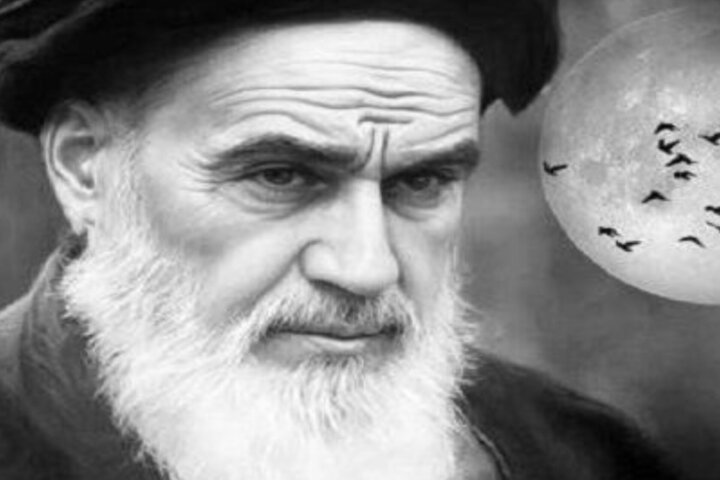
Ayatollah Ruhollah Khomeini (1900-1989), better known as Imam Khomeini (RA), was a Muslim cleric, Marja, and the leader of the 1979 Iranian Revolution, which overthrew the last Pahlavi Shah, Mohammad Reza Pahlavi.
He subsequently became the Leader of the Islamic Revolution, the paramount figure in the Islamic Republic's political system, until his demise.
In a noteworthy move to accurately document the history of the Islamic Revolution, the book "Alif-Lam-e Khomeini" has been published by the Political Research Institute as the most comprehensive, coherent, and well-documented historical research on the life of Imam Khomeini.
This monumental work is the result of years of effort and meticulous research by Hedayatollah Behboodi, a renowned researcher and historian in the field of contemporary history, who presents an unadorned and documented narrative—from birth to victory—of the founder of the Islamic Republic of Iran, using an analytical and critical perspective.
The book is organized into a single 1,157-page volume divided into 18 distinct chapters. Its orderly structure and precise chaptering meticulously trace the path of Imam Khomeini's life from his father's house in Khomein to the nation's home in Behesht-e Zahra, with remarkable detail. Behboodi does not merely narrate in this work; by placing each event within its historical and social context, he provides analyses essential for understanding the logic of the Islamic movement.
The first and significant section of the book is dedicated to the formative period of Imam Khomeini's scientific and spiritual personality.
With historian's precision, the author details his childhood and early education in Khomein and then Arak, identifying the pivotal point as his migration to the Islamic Seminary of Qom.
In this section, described as "forty years of fruitful silence," the reader becomes acquainted with the depth of the Imam's seminary activities: from teaching advanced levels of jurisprudence and principles to instructing the philosophy of Mulla Sadra and theoretical mysticism; from mentoring influential students like Shahid Motahhari and Dr. Beheshti to authoring enduring works such as "Kashf al-Asrar" and "Sharh-e Hadith-e Jonud-e Aql va Jahl".
Drawing on documents and memoirs of contemporaries, Behboodi paints a vivid picture of a source of eminence who was concerned with reforming the seminary and addressing the intellectual doubts of his time.
The Imam's transformation from a scholarly authority to a revolutionary leader is the axis of the book's second part. The author does not portray this shift as sudden or emotional but rather as stemming from that same deep foundation of political jurisprudence and his understanding of a Marja's responsibility in the face of an oppressive government.
Chapters concerning the protest against the "Provincial and State Councils Bill" in 1962, as the first official confrontation, and then the fiery sermon on Ashura in 1963, are narrated with details from court documents and SAVAK reports.

Behboodi shows how the Imam, relying on his spiritual and social influence, steered the discourse of struggle from limited reforms towards confronting the very foundation of the Pahlavi regime.
The section on the Imam's exile to Turkey and then to Najaf is among the book's brilliant chapters. The author not only focuses on his struggles and declarations but also, using the memoirs of close associates and private letters, presents a human image of the Imam's longing for Iran and his concerns for continuing the movement.
The analysis of the "Velayat-e Faqih" lectures in Najaf and their impact on forming the theory of Islamic government is a strength of the book's analysis in this part.

The final chapters of the book cover the peak years of the struggle, from May 1977 and the beginning of suspicious deaths to December 1978 and the triumphant return. Behboodi skillfully demonstrates how Imam Khomeini, from the farthest point of exile, managed events inside Iran, harmonized a wide spectrum of groups under a single leadership, and with timely speeches and messages, charted the revolution's course at its most critical moments (such as the event of September 8, 1978).
In a detailed interview about the challenges of this research, Hedayatollah Behboodi states: "Working on two completely different periods was like navigating two separate minefields.
For the first period (scientific life), the main problem was the scarcity of written, official documents, and we were forced to construct a coherent picture from scattered fragments of memoirs and a few writings.
But for the second period (struggle), the problem was the abundance and sometimes contradiction of documents; from SAVAK and court documents to the memoirs of various actors with sometimes conflicting motives.
The historian's duty is not to drown in this multitude but, by cross-referencing documents and critical verification, to arrive at a narrative closer to the truth, being careful not to fall into the trap of emotional or propagandistic narratives."
More than anything, the book "Alif-Lam-e Khomeini" is a response to the necessity of "documented and impartial historiography."
Reported by Tohid Mahmoudpour







Your Comment