

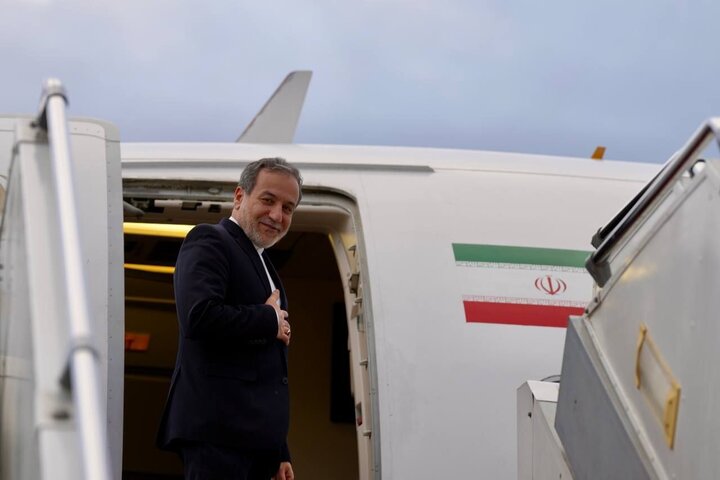
Foreign Minister Abbas Araghchi’s aircraft officially listed Tabas as its point of departure before heading to Muscat, where nuclear negotiations between Tehran and Washington are scheduled to resume on Thursday morning.
The choice of Tabas — a remote desert region in central Iran — immediately drew attention among political observers, as it is historically associated with the failed 1980 US military operation known as “Operation Eagle Claw,” which collapsed in the same area due to mechanical failure and harsh environmental conditions.
The symbolic timing of the flight comes as tensions between Iran and the United States have sharply increased. In recent days, Washington has made serious threats toward Tehran, reinforced by expanded US naval deployments in nearby waters and continued economic pressure through sanctions.
US officials have framed the latest military movements as defensive and deterrent in nature, while Iran has repeatedly warned that any miscalculation would carry serious consequences for regional stability.
Against this backdrop, Tehran’s decision to highlight Tabas as the starting point of its diplomatic mission can be interpreted as a deliberate reminder of historical precedent.
Tabas holds a unique place in modern Iranian-American history. On April 24, 1980, the US Delta Force, which sought to release the US Embassy staff held in Tehran, suffered from a humiliating defeat in Tabas Desert in northeast Iran. The US military was trying to carry out a covert operation in Iran at the order of then-President Jimmy Carter. The operation, known as Eagle Claw, failed due to major sandstorms in the Tabas desert, in today’s South Khorasan Province. The botched American mission was an attempt to release 52 Staff of the US Embassy [known as the den of espionage] who had been held in Tehran following the Embassy takeover by Iranian students in Iran after the 1979 Islamic Revolution.
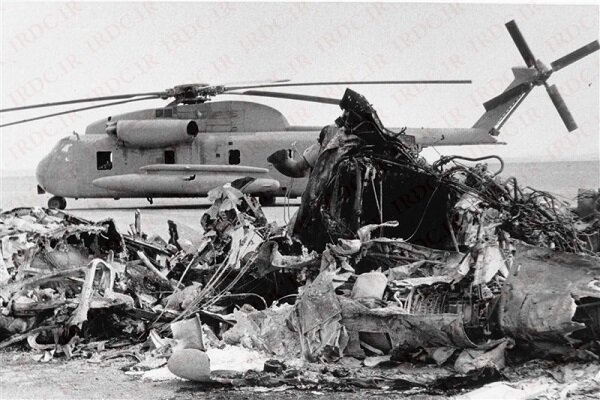
More than four decades later, Tabas remains a powerful symbol in Iran’s strategic memory — frequently referenced in official discourse as evidence of the limits of military intervention.
The nuclear talks in Oman are taking place amid a deep mistrust. The current round of talks unfolds against a backdrop shaped by earlier negotiation processes that collapsed amid military escalation. On June 13, 2025, Israel launched a blatant and unprovoked aggression against Iran while Washington and Tehran were in a process of nuclear negotiations. The Israeli attack triggered a 12-day war that killed at least 1,064 people in the country, including military commanders, nuclear scientists, and ordinary civilians. The United States also entered the war by bombing three Iranian nuclear sites in a grave violation of international law. In response, the Iranian Armed Forces targeted strategic sites across the occupied territories as well as the Al-Udeid air base in Qatar, the largest American military base in West Asia. On June 24, Iran, through its successful retaliatory operations against both the Israeli regime and the US, managed to impose a halt to the aggression. Those episodes established a lasting perception that negotiations were not pursued by the US as a mechanism for de-escalation, but were used as a cover while military pressure was applied on the ground.
As negotiations resume in Muscat, Iran’s posture reflects a dual-track strategy that has been repeatedly signaled in recent months. Diplomatic engagement remains the stated priority for addressing disputes and reducing tensions, with negotiations declared as the preferred path to resolving outstanding issues.
At the same time, this emphasis on diplomacy is paired with clear signals of military readiness. Alongside openness to dialogue, Iran has maintained that it remains fully prepared to respond to any form of military aggression, underscoring that engagement does not equate to vulnerability. The message accompanying the talks suggests that diplomatic flexibility is bounded by firm red lines tied to national security and sovereign interests.
This combination of diplomacy and deterrence shapes the environment in which the Muscat talks are taking place. Several hours before the scheduled talks in Muscat, Iranian Foreign Minister Abbas Araghchi outlined this stance in a message posted on X, underscoring a diplomacy rooted in experience rather than optimism, saying that Tehran enters diplomacy with open eyes and a steady memory of the past year while it engages in good faith and a stand firm on the country's rights.
Reported by Mohaddeseh Pakravan
Your Comment