

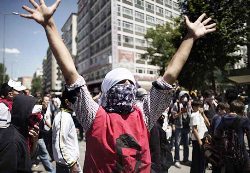
This fact might not seem very impressive to outsiders, but in Turkey’s highly polarized society collective protest of various pressure groups hardly exists. Hundreds of thousands protesters gathered at Istanbul’s famous Taksim Square on Saturday, June 1st. In the last two weeks, however, Turkey has been rocked by an unprecedented wave of protests, which had its starting point in the small Gezi Park, located on Istanbul’s European side. Following the example of #occupywallstreet the initial sit-in at Gezi Park was named #occupygezi by its initiators who had a certain agenda in mind. But Erdogan, the actual addressee of their protest, does not understand their message; just as the protesters do not consider that their message could be illegible for Erdogan. To grasp the reason for this massive misunderstanding one has to see that “Erdogan vs. #occupygezi” is the encounter of representatives from two generations which speak different languages but have a particular link to the city of Istanbul.
In 1806 the Halil Pasha Artillery Barracks were built in the district of Beyoglu on Istanbul’s European side. It was a beautiful building, designed by the famous Armenian architect Krikor Balyan. The Artillery Barracks served as such until 1909, when it got severely damaged during the 31st March incidents of the counter-coup, staged by the Ottoman Sultan Abdülhamid II against the Young Turks. In the following the Artillery Barracks lost their importance. In the 1920s the courtyard of the building was reconstructed into a football stadium called Taksim Stadyumu. In the years to come Turkey changed politically and socially in an unprecedented way. So did Istanbul. Mustafa Kemal Atatürk, who was a modernist, wanted to get rid of the “Ottoman dust” that covered the city. He considered the Ottoman past as backward while he idolized “Western” values and lifestyle. Together with his mayor Lütfü Kirdar, Atatürk invited the French architect Henri Prost to Turkey and asked him to prepare an urban master plan for Istanbul. Prost’s plan was implemented from in 1939 onwards. Prost regarded Atatürk’s Cultural Revolution as a continuation of the French Revolution. He wanted to create a city that would symbolize modern Turkey’s renunciation of its Ottoman Islamic past and its embracement of western secularism. One of his key measures was to great public squares.
The Halil Pash Artillery Barracks and the Taksim Stadium were demolished in 1940 and replaced by a small park in 1943. Today’s Gezi Park was thought to be the “lungs” of the planned residential area. Since then, it served the “Istanbullus” as one of the last green oases in the middle of buildings that grew higher and bigger. Along the park the upcoming individual transportation created one of the most important traffic knots of Istanbul. Around the park and the place prestigious hotels, restaurants and company seats began to arise.
Turkey’s Prime Minister Recep Tayyip Erdogan knows this area quite well. He was born in the district of Kasimpasa, which is very close to Taksim Square and well known as a rather rough quarter. He grew up in an Islamic-conservative environment. The 1970s were a highly tumultuous period in Turkey’s history in which Kemalists used the military to suppress a strong leftist movement. The country was divided along the cold war ideologies. In 1975 the Taksim square was opened for demonstrations, the first time after 1928. In 1977 one of the largest May Day demonstrations led to a massacre of some 34 people who died on the square. In those years Erdogan began his political career as a youth member of the Islamist Milli Selamet Partisi (National Salvation Party), which was in strong opposition to the Kemalists but also to the socialist movement. The Kemalist establishment Erbakan’s Refah Partisi (Welfare Party), of which Erdogan became a leader, as a threat to Turkey’s secular order.
In 1994 Erdogan stepped out of the shadow of Erbakan, when he was elected mayor of Istanbul. Erdogan showed pragmatism by combating the city’s chronic problems, like the always-busy traffic, water shortage and environmental issues. Social housing sprung up all over the city to accommodate the dwellers who had come from the countryside, namely from the war torn Kurdish areas in the very east of Turkey.
In 1996 Erbakan won the parliamentary election and became prime minister. However, he was forced out of office by the allmighty military only one year after the elections. The Refah Party was forbidden. This was also a critical juncture in Erdogan’s life. Frustrated by Erbakan’s refusing attitude towards a change of the party’s political agenda, Erdogan left the Refah Partisi and established the Adalet ve Kalkinma Partisi (Justice and Development Party) in 2001.
Already one year later in 2002 Erdogan’s AK Party came to power. Although Erdogan and most of the party’s top brass were former members of the Islamist Refah Partisi, the AK Party had presented itself convincingly as conservative but also economically a liberal movement with the major aim to join the European Union. This probably attracted many voters and led to an impressive victory. The majority of Turks were simply tired of the old Kemalist establishment and other non-productive political parties. Erdogan’s AK Party was different. It was a party that put deeds first, invested into infrastructure, supported the industry, favoured the trade and created trust by foreign investors. AK Party members were pious Muslims but still with a sense for liberal democracy and very down to earth in their developmental policy. Additionally it made itself attractive to non-conservative segments of the Turkish society with crucial and overdue reforms realized in the following years.
Turkey’s economy, which was in a devastating condition by the end of the 1990s, recovered soon. Meanwhile Erdogan won one election after the other with impressive results. In the elections of 2011 the AK Party received nearly 50 per cent of the votes and was short of a majority to change the constitution just two mandates. Erdogan reached the peak of power. He was the undisputed leader in Turkey and became in the next years the most important and powerful figure since Mustafa Kemal Atatürk. With his new position he was able to confront the Kemalist elites, crack down on the Army and to establish the control over the presidency. In a certain megalomania the government proclaimed the seven “crazy projects” which should change the face of Istanbul once and for all. This included a new channel from the Bosporus to the Black Sea, a new bridge over the channels, a third airport. A minor project was the tunnelling of the Taksim Square and Gezi Park – and the resurrection of the Ottoman Fortress.
The recent protests began with a sit-in in the famous Gezi Park. The government was eager to tear down the park in order to rebuild the Ottoman Artillery Barracks, which would serve as a shopping mall. The protesters wanted to preserve the park. While the government and in this case especially prime minister Erdogan, was propagating this huge building project as yet another attempt to make Istanbul even more attractive, critics argued that it is rather the repetition of the past together with a neo-liberal agenda. The initial protests started at 28th May. The protesting group was pretty small. Around 50 environmentalists gathered at Gezi Park. Moreover there was a really peaceful atmosphere. People were doing Yoga-sessions and reading poems for instance. The situation changed dramatically when the riot police suddenly attacked the protesters with Water canons and tear-gassed them early in the morning of May 31st. The excessive use of violence against the peaceful protesters outraged people from all segments of the Turkish society. What started as a small protest developed into heavily violent riots and later into nation-wide anti-government protests. Until today three people died, thousands of people got seriously injured, six protesters lost their eyes and over 900 were arrested. Despite the excessive force the police used the protests steadily grew and spread to other cities.
Meanwhile Erdogan did not show any sympathy for the protesters. He argued that this would be a staged protest movement with the primary goal of overthrowing his democratically elected government. Most of the protesters were puzzled after these statements of Erdogan but at the same time became encouraged to teach him a lesson. They agree with him in the point that “it is not just about some trees”. Well, it is far more than that. It is about the growing authoritarian nature of Erdogan. It is about democracy. It is about being heard by the government. It is about being tolerated by the government, even if one has a different lifestyle than the one propagated by the government. It is about the systematic marginalization of religious minorities, like the Alevis or Christians. It is about press freedom. It is about respect for the principles people believe in. It is about Reyhanli and Turkey’s Syria policy and much more.
The protests are not anymore about the Gezi Park and the trees only. Many protesters feel intimidated by their prime minister. The Economist portrayed Erdogan as a medieval Ottoman Sultan in its last issue. Of course this was an exaggerated image, but many Turks believe that their Prime Minister became more and more authoritarian and arrogant in recent years. He does not accept any criticism, neither in the political arena nor from the civil society or the press. Although 50 per cent of Turkish population did not vote for the AK Party, Erdogan rules like he had won 100 per cent of the votes and could govern without taking other opinions and needs into consideration. This type of “majoritarian authoritarianism” is the most significant grievance of the protesters.
Another significant point mentioned by many protesters is police brutality. This was basically the trigger that escalated the peaceful protests and led to nationwide riots and anti-government protests. It is not the first time that the Turkish police approach that way. In recent years it has become a modus operandi. Similar scenes have happened several times in the past, for instance at May Day marches, before and after football matches and other protests criticising the political or social situation in Turkey. People are used to get tear-gassed by the police, which have become clearly an effective tool of dispersing peaceful demonstrations.
Yet another major grievance is about the Turkish press. Most of the TV stations and newspapers can be categorized as “pro-governmental”—may it be for ideological reasons or may it be since ongoing trials against critical journalists initiated by the AK Party intimidate them to speak out. This became very obvious in the very first days of the protests. There was basically no news coverage about the violent riots occurring around Taksim Square and other cities of Turkey. For instance, while CNN International was broadcasting live from Taksim Square, its Turkish sister channel CNN Türk was showing a documentary about arctic Penguins. One of the few Turkish TV stations broadcasting live footage from Istanbul and Ankara was Halk TV. Therefore, social media were crucial in spreading information about the events, but they were also used to organize the protest among the participants. Twitter for instance transmitted eyewitness accounts, pictures and videos that did not find their way into Turkish TV stations or newspapers.
Erdogan has not shown any sign of making concessions so far. The contrary is the case. He dismissed and insulted the protesters by calling them “çapulcu” which means plunderer or vagabond in Turkish. The protesters embraced this word and it became a running gag among them. As the evil brain behind the Gezi protests, Erdogan blamed the now major opposition party CHP together with foreign powers (he didn’t mention a country though) and the so-called “high-interest-rates lobby” (nobody really knows what he means with this). He showed a complete and concerning lack of insight with the protests and threatened the protesters repeatedly by saying things like “there are 50 per cent and we can barely keep them at home”, or that his patience is not endless and if the protests do not stop immediately “I will talk to you in the language you understand.”
However, the protesters at Gezi Park and those in other major cities of Turkey seem widely unimpressed by their prime minister’s obstinacy. They know that they are not just a “bunch of plunderers and vagabonds.” Erdogan’s stereotypes do not apply to them. These protests are very different and its major advantage is that its participants are highly heterogeneous. People of all segments of Turkish society are taking part in it. It is astonishing to see how such contrary groups like for instance pious Muslims and rather secular Socialists are getting along. Even the flags of Abdullah Öcalan, the imprisoned leader of the PKK organization that fought until recently for Kurdish separatism, and the flags of Mustafa Kemal Atatürk, who stands for Turkish nationalism and the indivisible integrity of the Turkish nation, can be seen side by side at Gezi Park. Another example are the supporters of Istanbul’s three major football clubs Besiktas, Fenerbahce and Galatasaray that unified and joined the protests—regardless of the well-known enmity among each other.
The heterogeneity of the groups protesting at Gezi Park makes it impossible for Erdogan and his government to stigmatize them. These groups have not had anything in common, until the police raided Gezi Park. It was the trigger and suddenly contrary parts of the already highly polarized Turkish society welded together through their common frustration with the government. It is not a Kemalist-motivated movement, nor a communist or extremist backed uprising. No, not at all. It is simply the onset of a civil awakening and the possible formation of a viable opposition to Erdogan’s undisputed rule. For now it is only a non-parliamentary opposition, comparable to 1968 movement in several European countries. Currently there is no political party that could canalize the demands of this unsatisfied group on a parliamentary level. The Gezi Park movement is a melting pot of different and partly contrary interests. The majority of the protesters are very young. According to a recent survey conducted by two social scientists of Bilgi University Istanbul, 39 per cent of the protesters are between 19-25 years old and 14 per cent are between 26-30 years old. 80 per cent of the protesters called themselves secular. 70 per cent did not feel close to any political party though. To make a long story short, the protesters are very young and without a clear political line. This generation developed its political awareness and sensitivity when Erdogan was already in power. They did not experience the tumultuous 1980s and 1990s. They do not care about Erdogan’s earlier achievements as mayor of Istanbul or as prime minister of Turkey. They want to be heard by their government. They also want the government to stop barging in their lives. However, their heterogeneity becomes a disadvantage when it comes to the articulation of political interests and parliamentary representation. For now it does not seem realistic to call the Gezi Park protests a thread to Erdogan’s political power. The chances that his AK Party will win the next elections are high. However it is also possible that a political party will emerge out of this jumble of young, modern, educated and unsatisfied people. They will not tolerate any longer authoritarianism and patriarchal or paternalistic policies by their prime minister. This is clearly a clash of generations and Erdogan has not understood the core of the issue yet. He keeps on characterizing these youngsters to his political archenemy, the Kemalists. Pro-governmental newspapers picked up this false accusation and compared the Gezi Park protests to the so-called “Republic protests”, which occurred in 2007 and were initiated by the Kemalist Cumhuriyet Halk Partisi (Republican Party) and the military in order to present Erdogan’s AK Party as anti-republican and a threat to the country’s secular order. Several pro-governmental journalists scrutinized the protesters by asking “where they have been in 1997”, when the democratically elected government of Erbakan was illegally forced out of office by the military. However, the protesters answered this ridiculous accusation in a typical humoristic manner, by referring to their age and arguing that “they were wetting their pants as they were babies back then.” Erdogan however is stuck in his past. He is regarding #occupygezi as a Kemalist-backed conspiracy that aims to force him out of office like it happened to his political mentor Erbakan in 1997. However, #occupygezi is not about modernists vs. conservatives. It is about being heard and treated as an equal part of the society.
It is up to Erdogan if these protests become a serious threat for his power or not. For now the people are demanding to be heard. If the Prime Minister does not show serious constructive attempts to solve the problem peacefully, the protesters will get more support. Recently Erdogan showed the willingness to meet with representatives of the protesters. The fact that some of these representatives had been chosen by the government and were not related to the Gezi protests in any kind, were disillusioning to the majority of the protesters.
However, it is wrong to speak of a “Turkish Spring”, following the “Arab Spring”. Turkey is still a democracy. Erdogan has been elected and his destiny will be decided at the ballot box. However, the Prime Minister’s stubborn behaviour costs Turkey’s credibility in the world. Once Erdogan’s “Islamic-Democracy” was propagated as a role model for post-revolutionary Arab States. After 14 days of protests against the government the “Turkish model” has lost its attraction and confirmed critics that also AK Party has not worked out yet how to govern a pluralistic society. Moreover Turks realized that they still have to quest hard for a deeper and just democracy.
Şafak Baş holds a M.A. in Political Science and Islamic and Iranian Studies from Heidelberg University. He works as an analyst and freelance journalist in Germany and Turkey with his main focus on Turkey and Iran.
MNA
END










Your Comment