


Today, the 6th of Ordibehesht on the Iranian calendar, is formally marked as “Sanandaj Day”, celebrating the founding of a city that has grown into the capital of Kordestan province and a vibrant centre of Kurdish identity.
Yet what truly distinguishes Sanandaj is the soundtrack that accompanies its daily rhythm. In 2019, UNESCO recognised the city as a Creative City of Music, making it the first and only Iranian urban centre to join that category in the network’s history.
That ecosystem has produced some of Iran’s most celebrated musicians, including the Kamkars, a family ensemble whose virtuosity carries Kurdish sound across global stages.
The Daf — a large frame drum wrapped in goat skin and cross-strung with delicate chains that rattle hypnotically when struck — is the city’s defining instrument. Nationally registered as a cultural heritage element, it has been propelled into contemporary music through innovative techniques without losing its spiritual soul.
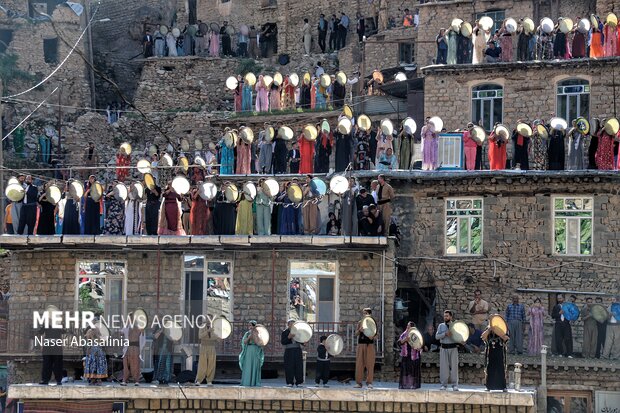
Sanandaj’s calendar is animated by festivals that draw performers and visitors from across Iran and beyond. The Fajr Music Festival brings together traditional and modern musicians, while the International Daf Festival gathers players from around the world to honour the percussion instrument that defines the region’s soundscape. Among these, however, one event stands apart for its sheer spiritual force: the Hezar Daf (Thousand Daf) ceremony, held each year in the stepped village of Palangan, roughly 75 kilometres from the city centre.
Palangan is itself a spectacle — a stairway settlement where the flat roof of one stone house serves as the courtyard of the next, cascading down a Zagros mountain slope. During the Hezar Daf gathering, thousands of Daf players line those rooftops and the riverbanks below, striking their instruments in unison as chants and poetry fill the air.
The city’s fabric: food, dress and craft
Sanandaj’s cultural identity extends well beyond music. The city’s culinary tradition is anchored in dishes that reflect the rugged geography and pastoral economy of the Zagros foothills. Visitors encounter a deeply local menu: kalanah, a flatbread stuffed with wild mountain greens, fresh cheese and crushed walnuts, griddled golden and served with a dollop of tangy yoghurt; Shish Kabab, marinated chunks of lamb threaded onto skewers and grilled over open coals until smoky and tender; and Khoresh-e Rivaas, a seasonal rhubarb stew that balances tartness and sweetness, slow-cooked with herbs, lamb and a whisper of saffron.

The visual signature of Sanandaj is instantly recognisable in its dress. Men wear shal trousers — loose-fitting and gathered at the waist with a thick cummerbund — topped with embroidered felt vests whose patterns tell local stories. Women appear in long, vividly coloured gowns and gauzy scarves threaded with gold and silver, each stitch a marker of regional identity.

Monuments and landscapes
The city’s architectural landmarks anchor its historical narrative. The Salar Saeid Mansion, a Qajar-era jewel, now houses an anthropology museum whose holdings include tribal jewellery and illuminated manuscripts. The Asef Vaziri Mansion, with its intricate stonework and stained-glass windows, draws visitors year-round, as does the Dar al-Ehsan Mosque.

Nature frames the city on all sides. Abidar Park, a terraced hillside complex that overlooks the urban sprawl, provides panoramic views of Sanandaj and serves as a gathering point for families and hikers.

The best times to visit Sanandaj are spring and early autumn, when mild weather aligns with the city’s festival calendar and the surrounding mountains are at their most inviting.
Reported by Mohaddeseh Pakravan
Your Comment