

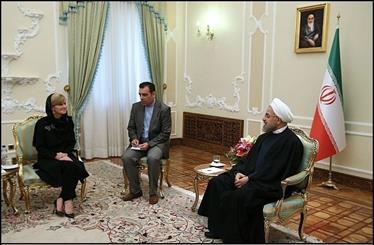
President Hassan Rouhani received Australian Foreign Minister Julie Bishop on Saturday in Tehran, where they discussed regional developments, Yemen, ISIL, and bilateral relations.
President Rouhani touched upon the most pressing issue of the Middle East, namely, Yemeni crisis and the ISIL in Iraq; “any effective and informed fighting of terrorism should focus on cutting the way by which young unsophisticated people are recruited by ISIL and other extremist terrorist groups, through delving deep to find the roots of the infamous culture,” Rouhani added.
“Terrorism is a grave threat to the region and humanity as well; we should persuade the states and nations to respond timely and equally to cruelty and injustice against innocent civilians setting aside all ethnic, religious and racial considerations,” president told Australian official.
“The Islamic Republic of Iran hails cooperation with any country including Australia in any campaign against violence, terrorism and extremism; we believe that in any conflict, political solutions should be preferred and sought,” asserted he, illustrating his case with the example of Yemen, where Rouhani believed, a disaster was underway, and that the solution to Yemeni crisis as well was political; “bombing innocent civilians would not solve the issue,” he said.
Rouhani proposed that the UN send truth-finding delegation to investigate the fact that who had been killed during more than 20 days of airstrikes. He lamented the fact that the international community had deviated from the right track in addressing Yemen; “even now, there are huge problems in sending humanitarian aid to affected people; we would cooperate and negotiate with any regional or international partners to end the bloodshed,” Rouhani emphasized.
“To disentangle the accurate approach from inaccurate policies, we should review the political history of the region in recent few years, which would clearly indicate the difference between our position and other players' position in Afghanistan, Iraq and Syria and that which position has been on the side of the truth,” Rouhani asserted, pointing to the US invasion of Afghanistan and Iraq more than a decade ago.
“In Syria, from the very beginning and in the dawn of the uprising, we discouraged providing arms and logistics to terrorists; now all know how is the situation in Syria,” Rouhani emphasized.
President Rouhani then touched upon the issue of refugees and the displaced in the region, who, he warned, would be attracted by terrorism magnets unless their problems were seriously addressed.
Australian foreign minister for her part praised Islamic Republic of Iran’s official position in fighting terrorism and roots of extremism; Mrs. Julie Bishop said that the proposal made in the UN by President Rouhani would provide favorable grounds for stripping terrorist groups of much of their attraction and of recruitment power.
She pointed to the same line of policy by Australia and Iran in supporting Iraq against ISIL. “Both countries believe that the ISIL should be fought and destroyed; it has inflicted much suffering and destruction on Iraqi and Syrian public; we both believe that Iraqi current government needs international support to defeat ISIL,” said Bishop, expressing concerns over ISIL poisonous ideology which fueled the sectarian strife in the region and conflicting approaches by countries in the region in addressing Iraq, Syria, and Yemen, reiterating her country’s position that Yemeni crisis would be resolved through a political solution.
She also pointed to Canberra’s support for Iran and the 5+1 negotiated joint statement; “if sanctions regime falls, it will be a new era of relations between Iran and the rest of the world,” said Australian FM.
Bishop also said that she had welcomed Iran’s president’s proposal to the UN, WAVE, which, she believed, would delineate the country as positive weight in promoting global peace.
SH
MNA
END
2536688








Your Comment